If you have been reading property listings in Marrakech or Dubai, the word “gated” appears again and again. So what is a gated community, and what does the word actually promise a buyer? This guide sets out the definition researchers use, the main types, the honest answer on safety, and the questions worth asking before you commit to one.
What a gated community is: walls, gates and a shared set of rules
A gated community is a neighbourhood enclosed by walls, where entry by non-residents is restricted or controlled by gates, CCTV or security staff. It usually has private roads and a shared code of conduct that every resident accepts when they buy.
Researchers at the University of Glasgow’s Department of Urban Studies describe gated communities as residential areas “fenced or walled-off from their surroundings, prohibiting or controlling access by means of gates or booms”. Blandy’s 2007 study in People, Place and Policy adds the other half of the picture: private roads and a shared legal code governing how residents behave.
In practice, the definition has three working parts:
- The perimeter. A wall or other physical boundary that marks exactly where the community ends.
- The access points. A gatehouse, a barrier, a key card reader or an intercom, so that entry is restricted access rather than open to anyone passing by.
- Private roads and shared rules. Streets and grounds are held and run privately, under rules that owners sign up to.
Take away any one of the three and you have something else: a walled garden, a guarded apartment building, or simply a quiet private lane.
Gated vs non-gated: how it differs from an ordinary residential area
The gate is the visible difference, but it is not the only one. What changes is who can come in, who owns the streets, who pays for services and which rules apply.
The University of Glasgow researchers note that residents of gated communities pay privately for services a local authority would otherwise provide, and Blandy points to the private roads and shared legal code that come with them.
For a homeowner, this means buying two things at once: a home, and membership of a small private system with its own budget and its own rules.
| Aspect | Gated community | Ordinary neighbourhood |
|---|---|---|
| Boundary | Perimeter wall or barrier | Open streets |
| Access | Controlled by gates, CCTV or staff | Open to anyone |
| Roads and grounds | Private | Public |
| Who pays for services | Residents, privately | The local authority, from general taxes |
| Rules | Shared legal code of conduct | General planning law only |
The table explains why two homes of similar size can come with very different running costs and obligations. Inside the gate, the common areas are yours to share and also yours to fund.
The main types of gated communities
Not every gate exists for the same reason. The main types differ in what the enclosure is really there to protect:
- Security-led enclaves. The gate is the point, and a guarded entrance is the main thing residents pay for.
- Golf and lifestyle communities. Built around golf courses, a clubhouse and other recreational facilities, where the amenity is the draw and the gate protects it.
- Prestige enclaves. The gate signals exclusivity and prestige as much as it keeps anyone out.
- Retirement communities. Often age-restricted, with services planned around older residents.
- Serviced projects. Branded projects where concierge-style services sit inside the residence itself rather than in separate shared buildings.
Within these types you will find single-family villas, townhouses and apartment communities. Gated communities typically add a set of shared amenities, which can include swimming pools, a gym, tennis courts and planted gardens.
The model is no niche. In Fortress America, the foundational study by Blakely and Snyder, the Brookings Institution reports that new homes in over 40 percent of planned developments in the West, South and south-east of the U.S. are gated. At that scale, the gated development stops being an exception and becomes a mainstream form of housing.
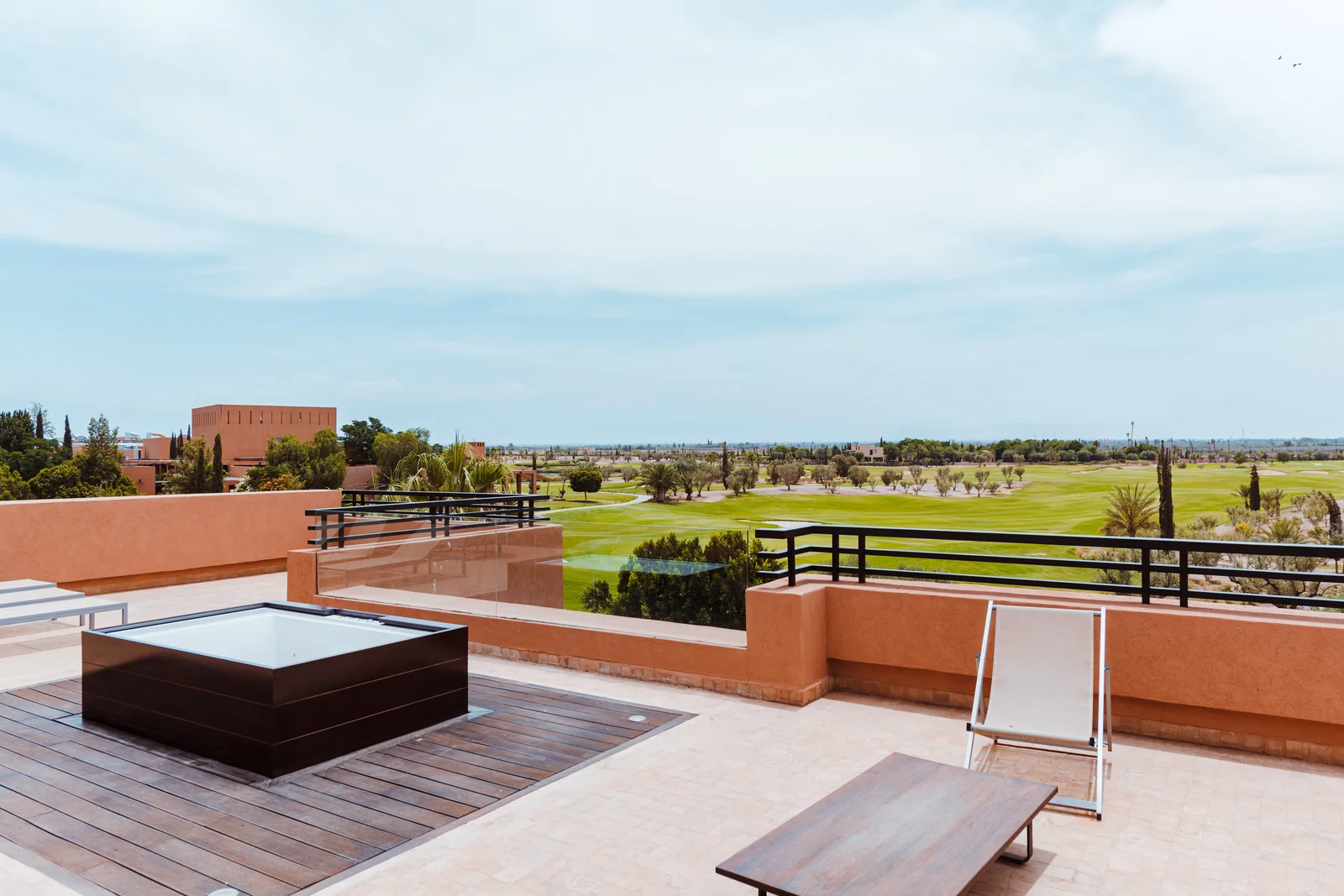
Marrakech has its own version of the golf and lifestyle type. Our golf-estate villas at Al Maaden show what living beside a course looks like day to day.
Are gated communities actually safer?
It is the question most buyers ask first, and the evidence is less clear-cut than the listings suggest. Blandy’s comparison of gated and ungated areas found no significant differences in crime rates. Police also reported slower response times, because locked gates held them up.
The national study led by Atkinson for the Office of the Deputy Prime Minister recorded another downside: heightened anxiety about crime among residents. Living behind a wall can make some people more aware of risk, not less.
Some agents and lenders claim that gated communities have lower burglary rates. That claim usually arrives with no study attached, and the research that did measure crime found no difference.
What the gate does deliver is controlled access: fewer strangers, little or no through-traffic, and security guards who know who belongs. Gates, cameras and security personnel enhance security at the entrance, and together they give residents a sense of security and privacy. Treat safety and security as one benefit among several, not as the reason to pay more.
The benefits of living in a gated community
The strongest arguments for gated living have little to do with crime statistics. Why people choose these communities was one of the questions the national study by Atkinson and colleagues set out to answer, and the everyday reasons are easy to recognise:
- Privacy and calm. Low density and no through-traffic make for a peaceful living environment.
- Grounds you do not have to organise. Gardens, roads and the wider landscape stay well-maintained by staff paid from the shared budget.
- Facilities you would not run alone. Gated communities offer pools, gardens and sports facilities that would be costly for one household, with exclusive amenities reserved for residents.
- Neighbours you recognise. A small, settled group of residents can bring a sense of community and a sense of belonging, and shared spaces make it easy for residents to connect without planning it.
- A calmer daily routine. For families, a sense of safety when children play outside is often reason enough.

For owners who spend much of the year abroad, there is one more benefit. Staff at the gate and managed shared grounds mean the property is watched while they are away. Owners can pair that with rental management in Marrakech, so the home itself is let, cleaned and maintained between visits.
The cons of gated communities
The downsides of living in gated communities are the price of the benefits above, and they are worth knowing before you buy:
- Charges that never stop. Residents pay privately for gate staff, roads and grounds, every year, whether they are in residence or not.
- Rules and regulations. Alterations to your home, letting, pets and the use of shared spaces are governed by the written code Blandy describes.
- Slower access. Guests, deliveries and emergency services all have to get through the gate, and Blandy notes that police response slowed where gates were locked.
- Neighbour disputes. Atkinson and colleagues recorded internal conflict between residents as one of the adverse effects they found.
The wider critique, raised by the University of Glasgow’s urban studies researchers, concerns social division: walls that separate one group of residents from the city around them.
None of this makes the model a poor choice. It means the cons of living behind a gate are known in advance and can be checked, which is what the final section of this guide is for.
Who runs a gated community, and what the service charge pays for
Every gated community needs someone to staff the gate, pay the gardeners and enforce the rules. Governance structures and legal frameworks were a core strand of a national study of gated communities. The set-up varies with each country’s property law, but it usually combines:
- an owners’ association that represents the residents;
- a management company or managing agent that runs day-to-day operations;
- a leasehold or co-ownership structure for the shared parts;
- a written code of conduct or bylaw that every owner accepts.
Some listings call the governing body a homeowners’ association, or HOA, and its charge HOA fees. Is an HOA the same thing as a gated community? No. The HOA is the body that governs many gated communities, and the gate is one of the things it pays for.
The service charge typically covers:
- staff at the gate and the entrance systems;
- upkeep of roads, lighting and common areas;
- gardening and landscaping;
- the running of shared facilities such as pools, a clubhouse or sports courts.
It is billed on a monthly or annual cycle, depending on the association.
So how much does it cost to live in a gated community? The purchase price, plus a recurring charge whose level depends on what the community runs. A development with a guarded gate and a garden costs far less to operate than one with a golf course and a full set of facilities.
What gated communities look like in Marrakech and Dubai
Gated living is not an imported label in Morocco. A 2025 paper in The Journal of North African Studies describes a “remarkable emergence of inner-city and peripheral gated communities” in Moroccan cities since the turn of the twenty-first century, studied alongside rising demand for security and its privatisation.
Amelkis is a clear example in Marrakech. It is a gated residential community laid out around a golf course, with access controlled at the entrance, minutes from the city yet entirely apart from it. Its appeal is the combination this guide has described: security at the gate, low density and mature planting inside it.
Around the city, the gated community idea often overlaps with golf-side living and luxury estates that mix villas and apartments. To see the range of housing options in practice, browse our villas for sale in Marrakech.
Beyond Morocco, Originn gives buyers access to property in Dubai through its partnership with Preeminent Properties, which opens developments by Emaar, DAMAC, Meraas and Nakheel, and it also works in Jeddah. The questions in this guide apply there too: who runs the community, what the charge covers and what the rules allow.
What to check before you buy or live in a gated community
A gate tells you very little on its own. What decides whether a community suits you is how it is run, and almost all of that is written down before you sign.
| What to check | Why it matters |
|---|---|
| Who manages the community, and under what structure | Governance decides how rules are made and money is spent |
| What the service charge covers, and how it has changed | Residents pay privately for services the city would otherwise provide |
| The written rules and code of conduct | They govern alterations, pets, guests and shared spaces |
| Letting permissions | They decide whether the home can earn when you are away |
| Guest, staff and delivery access | Locked gates slow down everyone, emergency services included |
If the home is meant to earn, confirm that short- or long-term letting is allowed and how tenants’ guests are admitted. Atkinson and colleagues also examined how gating affects property values, so treat any promised premium with caution and judge each community on its management and location.
For foreign buyers, the gate does not change the legal route to purchasing a home. The steps are the same as for any other property, and our guide to buying property in Morocco as a foreigner sets them out. If you plan to let the home, check how rental income is treated in your country of residence and whether a double taxation treaty applies.
Before you commit, it helps to have someone read the rules, the accounts and the management contract alongside you. Speak with our advisory team and we will go through them for any community you are considering.
What the gate really buys
The wall and the barrier are the visible part. What you are really buying into is the management behind them: the people who run the community, the rules they apply and the budget they spend.
So what is a gated community, once the listing language is set aside? A neighbourhood defined by its boundary, its controlled entrances and its shared rules, chosen for privacy, calm and cared-for grounds rather than a proven drop in crime. If you are weighing one in Marrakech or Dubai, arrange a private conversation with Originn’s advisors.
Other questions buyers ask about gated communities
Can anyone enter a gated community?
No. Residents, their guests and authorised staff or deliveries get in through the gate, a guard or an intercom, and anyone else has to be let in. That control over entry sits at the core of Blandy’s definition of a gated community, alongside private roads and shared rules.
Where are gated communities most common?
Gated communities are found worldwide. Blakely and Snyder, as reported by the Brookings Institution, found new homes in over 40 percent of planned developments gated in parts of the United States. Blandy counted upwards of 1,000 in a single European country, mostly small ones. A 2025 study in The Journal of North African Studies traces their growth in Moroccan cities since around 2000.
Are gated communities privately owned?
Partly. Each home belongs to its owner, while the roads, gates and shared grounds of a gated community are private and held or managed collectively, usually through an owners’ association and a managing agent. Blandy’s definition highlights these private roads, and the University of Glasgow researchers note that residents pay privately for the services on them.
Is buying in a gated community a good investment?
It can be, but the gate alone does not make it one. The national study for the Office of the Deputy Prime Minister examined how gating affects property values, and no rule of thumb replaces checking the specific community: its management, its location, its charges and whether its rules allow letting.
Can foreigners buy property in a gated community in Morocco?
The gate itself does not change the legal route for a foreign buyer in Morocco: buying a home inside one follows the same process as buying any other home there. The rules, costs and steps for non-residents are set out in Originn’s buying guide, and the community’s own code of conduct then applies once you own the home.